|
| Coventry's first Folk Club - The Binley Oak |
15 Folkin' Years
Late one evening, whilst loitering within tent, pitched in the middle of a folk festival campsite, i was listening to a cassette of an early Dando Shaft album, when i heard a knock on the canvas. "Excuse me" said the caller "but I couldn't help hearing the music. That's Dando Shaft isn't it?" "Yes" I replied "I haven't heard their stuff for ages, I wonder what they are up to now?" I asked him where he came from and he told me London. I told him I lived in Coventry and that several of the band were still living in the area, playing gigs as soloists, duos, trios or any other combination that seemed appropriate. We chatted about the band and their music and generally about the 'good old days' where many of today's big contemporary folk acts were still up and coming. That encounter got me thinking about the earlier days of the Coventry folk music scene. I don't mean the camp fire sing songs that undoubtedly took place when the city walls were being built and Royalists and Parliamentarians were knocking each other about; i mean the days within living memory of many of today's established folk musicians -
....Barry Skinner, Sean Cannon, John and Beverley Martin, Hedgehog Pie are among many of the names connected with the Coventry club circuit and promising new acts are still evolving. Waterfall, who are becoming another well respected act throughout the country, and were even featured recently on Radio One's Kid Jensen programme (a supreme accolade), owe much of their stage experience to the relatively recent floor spot appearances at the Firkin, Magic Lamp and Lanchester Polytechnic Folk Clubs. The New Modern Idiot Grunt band is still going as strong as ever, much to the delight of club organisers throughout the country who had previously heard of them disbanding a few years back.
 |
| Ben Arnold |
An article by Ben Arnold in that publication pinpoints the exact beginnings of the present day format of folk clubs in the city. Of course, singing in pubs is a tradition that dates back tot he opening of the very first pub, although not everybody appreciated the vocal talents of these songwriters. It wasn't until 1962 that moves were made to organise a folk music venue where people who did want to hear folk singing could go in peace.
This was the Coventry Arts Umbrella Club, which existed for the benefit of those who enjoyed art and music in general. It provided an opportunity for the pioneers of Coventry Folk including Ron Shutttleworth (more recently a regular at the Colin Campbell's Monday night sessions) and Barry Skinner to generate an interest in folk music.
The regular get together's at the Umbrella Club only catered for a minority interest but it did serve as a starting point for dedicated individuals to plan Coventry's very first folk club. This was opened one Thursday in May 1963 at the Binley Oak, Paynes Lane and was called, suitably enough, the Coventry Folk Club. To quote Ben Arnold, "Coventry's first folk club was formed out of a common love of what at that time was an esoteric form of expression and desire to bring to the public at large something which had been theirs for hundreds of years.
The hosts were the Troubadours, a group formed by Barry Skinner and consisting of John Allen, Lee Soloman, Pete and Marlene Roberts, Terry Illingworth, Brian Sutton and Bob Bruce, although not all at the same time. Also involved with the band were Brian Curtiss and Dick Newton who later joined the Down Country Boys.
Barry Skinner however was the main driving force behind the formation of the Coventry Folk Club. Floor singers became a regular feature of the club, partly because the residents didn't have enough material to cover the whole evening every week without repeating themselves too often. Most of the music played was either traditional folk or skiffle. At the time there was a limited choice of traditional songs easily obtainable as few had been 'collected' and published in books or anthologies.
For well over a year, the Binley Oak was the only place in the city where one could go and listen to live folk music on a regular basis, although interest in folk music gradually spread as more and more enthusiasts and musicians visited the club. An attempt was made in August 1963 to start another club at the Cheylesmore Community Centre but this proved to be nowhere near as successful as the Coventry Folk Club. It met for a short while on Friday nights but lacked support due to its out of the way location, lck of beer and the fact visitors to the club had to become Community Centre Members. Nevertheless it helped to spread the word of folk in Coventry. (I was involved with a one-off concert at the centre in 1975 and we managed to sneak some beer in. The highspot of that evening was when the centre's drama club pulled off a "This is your life" stunt on the guest, Dave Bennett, whilst he was on stge. But that's another story!
In June 1964, the Tavern Folk Club opened and met every Sunday at the Swanswell Tavern. Ben Arnold was the compere and among the many acts establishing themselves were the Kerry Singers. The venue was short lived, although the club was successful; they moved to the Wine Lodge in the Burges and the club became known as Cofa's Tree, deriving its name from the Anglo-Saxon name for the Coventry. (How ethnic can you get?). This became a very important club in the development of folk music in the city and was very well attended. The change of venue had been made to accommodate the growing numbers of audience which regularly topped 200. The Kerries, which included Gibb Todd and also Gill Thurlow, who later married David MacWilliam, were the resident band and top guest artists were booked. One young lady who made regular appearances as a singer / guitarist was a Beverley Kutner (later Beverley Martyn - John Martyn's wife). Also seen performing there on occasions were the Furies. The Kutners were the family that ran the Jewelers shop with the big clock , on the corner opposite the old school.
In 1965 the Coventry Folk Club also moved, forsaking the Binley Oak for the larger and more centrally located Craven Arms in the High Street - know known as the Bear. However it only lasted at this venue for about a year, to be re-opened at the Queen's Inn, Primrose Hill St in September 1967. This didn't last long either. As the folk scene developed and became more complex with a bigger choice of clubs facing the audience and more and more musicians getting involved with them, it was probably inevitable that some of the venues would change more rapidly. Perhaps the longest running meeting place for folkies first opened in 1966, this being the Old Dyers Arms, where the Coventry Folk Workshop and Singers' club was formed as a place where local enthusiasts could get together, play and sing, discuss and give each other positive criticism and to plan new projects ranging from Morris Dancing to musical instrument classes.
In the same year, another much remembered club saw the light of day, namely the City Arms in Earlsdon, hosted (at first) by Paddy Roberts. Many more singers were becoming known and liked by Coventry audiences at this time. Dave Coburn, who had assisted Barry Skinner in the general running of the Coventry Folk Club, had become an established local singer as had two other relatively new faces appearing regularly at the City Arms, Rod Felton and Rob Armstrong. In 1967 Rod took over the running of the club, with the help of his mother who sat on the door.
An interesting article in Issue One of Folk Crying Out Loud reads as follows;
THE CITY ARMS FOLK CLUB
"Revived some months ago....the club started anew with a policy of pleasing everyone's taste in folk music. By introducing new faces tot he scene, we have built up a formidable body of singers ranging from unaccompanied traditional songs to the comedy of the New Modern Idiot Grunt Band.
To date we have had now nationally known folk artists except for my good friends The Young Tradition.. who insisted in doing a free gig for us; they of course went down splendidly. Among other artists who have appeared are...The Down Country Boys, Andy and Jan...and a few weeks ago a fine blues artist by the name of Dave Kelly. This club has given Bob and I (and many others) a chance to experiment with new material and new approaches, which has proved very successful to the point that I very rarely sing the blues unless requested.
Given this chance, I would like to thank Rob Armstrong, a good buddy and a fine musician, for his running about and organising without which I am sure the club would have never survived. Also I would like to thank those artists who have stuck with us through thick and thin and helped to make the City Arms Folk Club a good Sunday Night's folk entertainment."
Rod Felton
Rod had started out in fact as a blues musician at a time when he and Dave Coburn, who used to do a lot of music hall material, were two of the very few "Contemporary" folk artists in the city.
Another regular at the club was a student, now a nationally known singer, June Tabor. Towards the end of 1967, she joined with a group called Cockade, which also consisted of Ken Woolfendon, Roger Bullen, Martin Jenkins and later Rob Armstrong. More of them later in the series.
1967 saw the birth of two more local clubs; - Oul Triangle, which met at the Admiral Codrington, and the Bandiere Rousseau at the Hen and Chickens. Oul Triangle gathered a large following and by the end of 1967 had a membership of some 600 people. Its hosts were Liffeyside, consisting of Steve Nagle (more recently with Mulliners Rough), Mick Gallagher, Martin Griffin, who left later and was relaced with another new face, George Van Ristell. The Hen and Chickens was probably the first Coventry Club with a strong leaning towards contemporary folk, hosted by John Lake, monologue specialist and driving force behind the Coventry Folk Workshop, and Ron Shuttleworth. It was popular with those who equated folk with politics, conveniently located across the road from the local Communist Party Headquarters and it's name meaning the Red Flag.
Another long running club first opened in January 1968, this being the Village Pump at the Bulls Head, Binley Rd. Many fine guest artists appeared here right up to its closure in 1976 but it was best known as a good place for folk dancing. It was also in 1968 that live folk music was first played at the Mercers Arms, where the club was hosted by Two's Company, who later went on to open the Bedworth Folk Club at Bulkington.
I've probably started missing out clubs already, but its clear that in a period of about five years the Coventry folk scene evolved very quickly and a great new source of musical talent ws making itself known. There is little doubt that the general standard of folk music in the city was, and still is high. Along with Bristol and reading, Coventry was reputed as being one of the greatest centres of good folk music in the country and some people now look back at the late 60's with nostalgia, feeling that perhaps some of the magic has been lost in the local folk scene. In those days there seemed to be more enthusiasm with many well organised clubs regualry attended by many people, most of whom didn't play an instrument but jsut enjoyed listening. it's interesting to note that today the only city centre club is the Lanchester Polytechnic and the clubs that book nationally known artists tend to be located in the outskirts, making it more difficult for many enthusiasts to attend them regularly.
Next issue, I'll be dealing with clubs that started in the early 70's. Any useful information is welcome....
Pete Willow 1978
.......................................................................................
This article frist appeared on the Hobo Coventry Music Site on Vox blogs in 2007 - now closed down and so these comment are from that blog.
UPDATE - the mystery of who created the graphic above has been solved (see Pete Willow's comments below) - I discovered The Coventry Terrygraph blog via serendipity (while searching for something else!) although Terry says he tried to contact me - unfortunately I didn't get his message - not to worry - I found him anyway!! Maybe Terry might tell us a bit more about himself - his artwork and music involvements in Cov!!
Here's a link to Terry Sycamore's blog The Coventry Terrygraph and blow a screen shot of the message I found there!!
The wonders of the net!

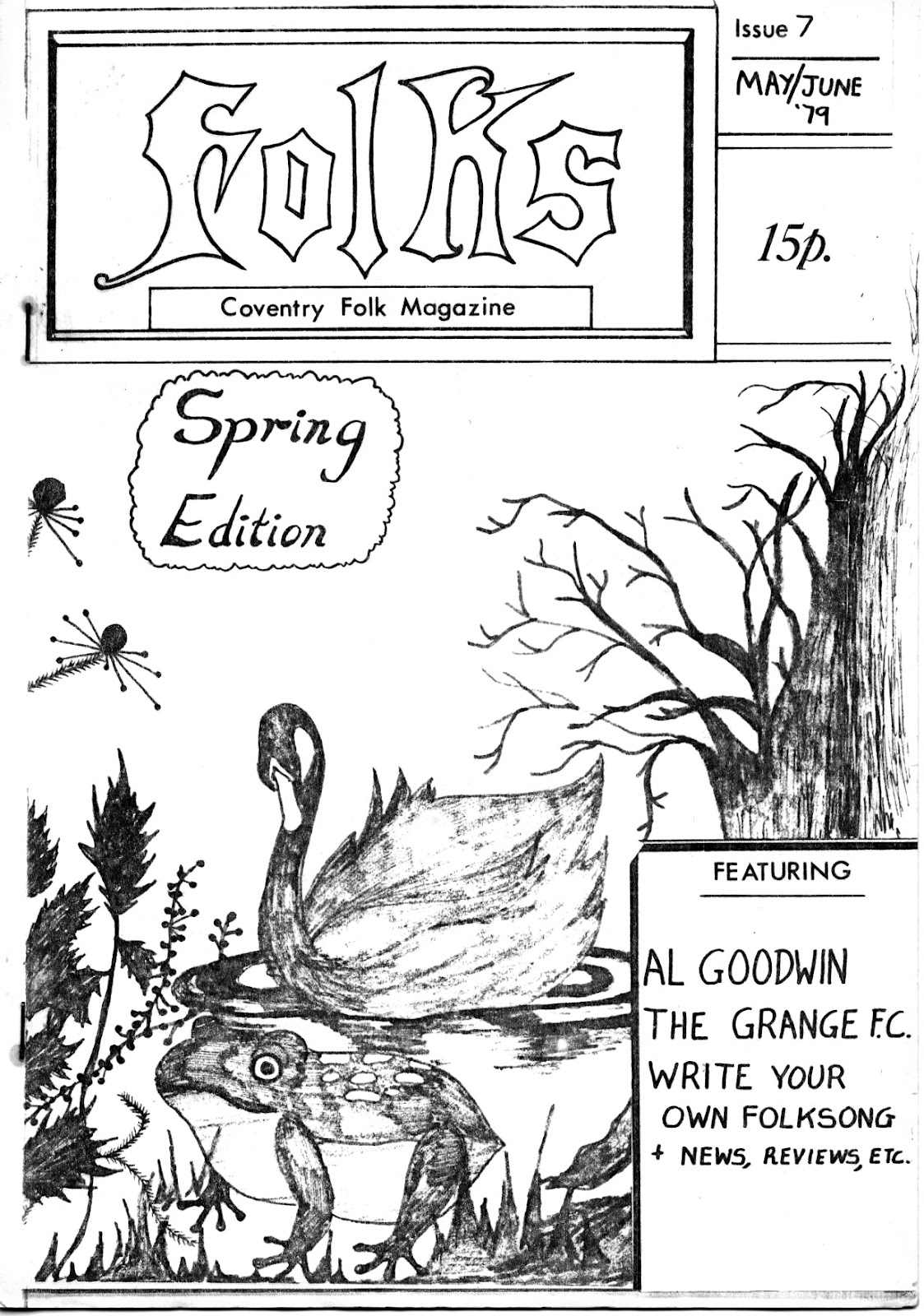
[this is good] I remember researching this - and Dennis Clarke putting together the superb cartoon of the Binley Oak! The correction re: Beverley Jones was published in the subsequent edition of Folks which, if memory recalls, included a detailed delve into the archives and scrapbooks of Rod Felton. I should have a full set of Folks somewhere. I will have a look for them over Easter and send copies to Trev.
Posted by: Pete Willow | 04/01/2007 at 09:43 PM
Yes have a vague memory of a schoolmate organising a first visit to the folk at the Umbrella,(he was enticed into Mummers I think).as an alternative to going to a Young Socialist coffee and record evening (then Coundon road )
Nice to see a mention of Ron, who is very important to us weird folks that go around dressed as strange animals and have shouted "In come I" in some far flung places, and nice that has come up over a weekend that we have been out in the caps and bells. (synchronicity ..as Lesley would say)
Also remember Barry Skinner., Beverley of course and a bloke called Carl, an ardent Communist who used to speak in the Precinct on a Saturday. he was quite elderly and I might have got this wrong , but I think he may have fought in the Spanish Civil War.( and probably not with us anymore) He new a lot of Revolutionary songs and his flat was overflowing with books you couldn't move. I am sure others will remember him, he rode a moped , and was one of the few people in those days to wear a crash helmet. On top of his he had a knight in armour made from a plastic kit, and holding a kids paper windmill. ( I do hope I wasn't imagining it)
I think it was him that gave me a book that introduced me to sea shanties, and encouraged me sing same. Embarrassed at the time but since very appreciative.
There were a lot of Communists in Cov in those days and they took their folk very seriously, it didn't surprise anyone when the Hen and Chicks started
When Dylan "sold out " they followed him around the country hurling abuse and calling him a "traitor to the proletariat" I think the Mag mentioned may have been. around the same time as the schism.. The Young Communist League was quite active at the time and had there own newsheet/paper which I think was duplicated at the TWGU offices.
Over the years I have noticed ( and discussed privately) just how many of the Early Folkie/YCL er's names crop up, often in the realms of higher education, although by now all most probably retired. Without mentioning any names, I do hear of or from many who frequented both the Oak and the Tavern, although I never went very often myself., but mainly the Hen and Chicks (handy for Hartford Arms' cheap cider) One, a very good floor singer is now in Thailand, another has recently returned from Australia.
According to another who has only recently left Cov, the Hen and Chicks was a good place for...( I de paraphrase) for meeting persons of the opposite sex, who might have enough brain to talk to, as well, as being free of strange ideas about monogamous relationships.etc.
Is it still there. I remember the big golden carved sign that looked more like a duck!
I look forward to hearing about other issues and do a bit more name spotting. Its opened up yet another area of the long forgotten. Thanks.
DD
Posted by: BroadgateGnome | 04/01/2007 at 10:51 PM
My memory's playing tricks on me. Apparently, the Binley Oak Folk Club cartoon wasn't by Dennis Carke (although he did some of the artwork for Folks Mag). Not sure whose it is - anyone recognise the style?
Posted by: Pete Willow | 04/15/2007 at 11:23 PM
Thanks Trev for tracking down the artist. Terry Sycamore - of course!!
Posted by: Pete Willow | 07/31/2007 at 03:33 PM
Desperately trying to locate Barry Skinner, can anyone help. Please
Posted by: Mary Shepherd | 02/20/2012 at 04:36 PM


a.jpg)