I was sent these by Mary Elson (wife of Ian Elson of Sneak's Noise) who says
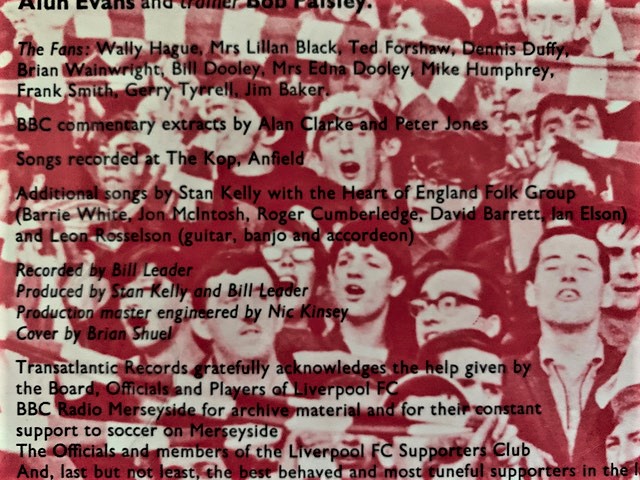
"I have a copy of a vinyl record on which "The Heart of England Folk Group" collaborated with Stan Kelly - a tribute to Liverpool Football Club. I am not sure whether you have this but it does list the group members at the time. The Heart of England) were from Coventry / Leamington.-
Stan Kelly with the Heart of England Folk Group with Barrie White,Jon McIntosh, Roger Cumberledge, David Barrett, Ian Elson
Barry Skinner was one of the pioneers of the Coventry Folk Scene in the 1960's, with sessions at the Coventry Arts Umbrella Club, besides other pioneers like Ben Arnold and Ron Shuttleworth. He formed the Troubadours a group formed by Barry Skinner and consisting of John Allen, Dee Solomon, Pete and Marlene Roberts, Bryan Sutton, and Bob Bruce. Terry Illingworth. although not all at the same time. Barry Skinner was the main driving force behind the formation of Coventry Folk Club. Floor singers became a regular feature of the club, partly because the residents didn't have much material to cover the whole evening every week. Most of the music was traditional folk or skiffle. For well over a year the Binley Oak was the only place in the city where one could go and listen to live folk music on a regular weekly basis although interest spread as more and more people became interested. In 1971 he made an album for Argo Bed Battle and Booze with Martin Jenkins of Dando Shaft on mandolin.
Barry Skinner started singing Folk Songs in the late 1950's. He formed the Coventry Folk
Club in 1962 and sang full time professionally from 1964 to 1980. In sixteen years on the road he sang in innumerable folk clubs throughout the British Isles as well as at concerts, festivals, colleges etc. He also sang at clubs, concerts and festivals in Holland, Germany, Spain and the USA. Along with over 200 TV and Radio appearances, three solo LPs and various compilation albums, it turned into a very busy and enjoyable sixteen years.
1980 brought a change. Barry had always had a great love, knowledge and interest in the canals and had for many years featured a programme of slides and songs about canals. He joined Coventry Education Waterways Scheme, which ran two narrow boats as “floating classrooms” and for the next five years travelled the length and breadth of the navigable canal and river system in England and Wales. He also appeared on many programmes about canals on radio and TV during this period.
In1985 he moved to Snowdonia, to work as an outdoor instructor, taking early retirement in 1998 as Chief Instructor and Deputy Head of Liverpool Hope University's Outdoor Centre at Plas Caerdeon, near Barmouth in Snowdonia.
Barry sings both Traditional and Contemporary songs, as well as many of his own compositions. He plays guitar and banjo and is accompanied on the keyboard by his partner, Anne. Together they guarantee an entertaining and enjoyable evening.
Barry once had his own 'Barry Skinner Folk Group' and played and recorded with Martin Jenkins in the folk/rock band 'One Day Thomas'.
Below Barry Skinner with Turpin Hero with Martin Jenkins of Dando Shaft on mandolin John McIntosh bass and Andy Smith guitar.
Below Barry Skinner with Turpin Hero with Martin Jenkins on Mandolin and John McIntosh bass and Andy Smith guitar
Below - Barry Skinner with John Barleycorn and 2 sound bites Admiral Benbow and The Sailor and the String.
Barry Skinner, who has died from cancer aged 71, was a popular singer and songwriter who made a strong impression on folk club audiences around the UK, also appearing in continental Europe and the United States, between the late 1960s and late 1970s.
The end of his touring days coincided with the start of a remarkably varied new professional life that was to embrace instruction in mountaineering and other outdoor activities, canal sailing, the construction of custom-made dolls' houses, photography, painting, camping and writing.
Those close to Barry tell the story of his life and times better than I can.
This is from his son Matt's eulogy at the funeral earlier this month (October 18): Barry was born in 1941 and grew up in the Coventry area. As a youngster, he was a keen sportsman, enjoying both football and cricket. He was apparently always taking up new hobbies, many of which would shape his interests in later life. He had something of the “butterfly” about him in this regard, as he would often abandon one hobby to throw himself wholeheartedly into his next.
As a young adult Barry took up climbing and in 1961, he took part in his first mountain rescue on the Isle of Arran. The following year, another of his great loves – music – led him to form The Troubadours, a folk group based in Coventry but with, at the time, nowhere to perform. Typically, Barry’s solution to this problem was to start the first Coventry Folk Club, thus solving the lack of venue problem, and beginning a phase of his life that would see him performing professionally across Britain, Europe and the US for more than a decade. Many of Barry’s own musical compositions were centred on his love of the inland waterways of Britain, and in 1979 he began to preach the “Gospel of the Canals” by working with the Coventry Education Waterways Scheme, which gave young people a hands-on experience of life on narrow boats, run as floating classrooms.
In the mid-eighties, Barry moved to Snowdonia where he became a freelance Outdoor Instructor and where he also bought Turnpike Cottage with his partner, Orianne. When asked why he moved such a long way from the place of his birth, Barry would usually reply, “There weren’t really many career opportunities for a Mountaineering Instructor in Coventry!” Turnpike provided the perfect setting for another of Barry’s creative activities: the designing and building of scale model dolls’ houses. Along with his love of painting, drawing, photography and wood-turning, the cottage soon became a hive of artistic production.
After the sad loss of Oreanne , Barry remained at Turnpike, shortly afterwards retiring from full time employment as Plas Caerdeon’s Chief Instructor: a decision described by Barry as “the best career move you can make!”
Some years later, he met Anne, in whom he found a fellow artistic spirit and the two of them lived at Turnpike, running a popular and successful Bed & Breakfast business.
Many guests were so impressed with Turnpike’s hospitality that they would book returns on a year by year basis. Indeed, several of Anne and Barry’s personal friends began their acquaintance as B& B guests. When they decided eventually to discontinue the Bed and Breakfast business, Barry and Anne bought a motor-home and enjoyed touring Britain, often writing articles for the national camping and caravanning press.
Motorhoming continued until the beginning of this year when Barry’s illness first manifested itself. The trips became shorter but no less enjoyable, the motorhome proving very useful when making long drives for hospital visits.
His final artistic venture was the Helfa Gelf art festival in September, when his paintings were on display to the general public both at home and in local art galleries. ...................
" I met Barry in Coventry in 1963/4 and he took me round the folk clubs before finally persuading me to get up from the floor at the Troubadours I think it was, I have a photo of Barry and myself performing there. We did this and a few other clubs before I decided I liked singing and wanted to join a group which I did, the Kerries who ran the Cofas Tree Folk club in Coventry. I turned professional whilst living in London and owe it all to Barry . I remember him fondly and talk about his friendship and influence quite often. Thank you Barry. Gil McWilliams (nee Sowter).
Posted by: Gil McWilliams | January 19, 2017 at 11:50 PM
(Gill was a singer with the Kerries and also the wife of David McWilliams who sand Days of Pearly Spencer.)
...........
“Mother get up, unbar the door, throw wide the window pane ...”
That’s the opening line to one of the best songs I know, of any genre. Beautiful and chilling by turns, it tells of a woman, married and settled with a family, who is visited, “outside in the vicarage lane”, by the ghost of an old lover, killed years before at the Battle of Alamein.
Don’t bother trying to find it on iTunes or YouTube or anywhere else that I can think of. It’s as obscure as Charles Causley, the poet who wrote it, and Barry Skinner, the folksinger/songwriter who put it to music and recorded it on an album, Bed, Battle and Booze, in 1971. Don’t bother trying to find that, either. The only copy I have any more is on a tape cassette, with no means to play it....With three under-appreciated albums under his belt, I don’t know whether he became discouraged by the lack of a breakthrough into a wider audience. But in later years, though he never gave music up altogether, Barry turned away from professional singing and moved to Wales. Always a talented artist, he drew, painted, worked as a wood-turner and built exquisite, individually designed dolls' houses to special order. The closing line to Mother Get Up runs: “I’m had by a dove in the tunnel of love; I can never come home again.”
A1 The Cheerful 'Arn A2 Bushes And Briars A3 The Dancers Of Stanton Drew A4 The Buxom Lass A5 Jack In The Green Written-By – Martin Graebe A6 Shepton Mallet Hornpipe/Dorset Four-Hand Reel B1 Admiral Benbow B2 Bread And Fishes Written-By – Alan Bell B3 Richard Of Taunton Dene B4 Stone-Cracker John Written-By – Martin Graebe B5 The Sailor And The String B6 Bonaparte's Lamentation B7 Wassail Song
ABROAD AS I WAS WORKING
Musicians
Barry Skinner: vocals, guitar Tracks Side 1Side 2
Lord of the Dance (2.00) Peace-Egging (Roud 614; TYG 53) (1.50) Joseph Baker (3.20) Knocker-Up Woman (2.20) Ratcliffe Highway (Roud 598) (2.10) The Deserter (Roud 493; G/D 1:83) (3.50) Honiton Lace (3.10) Peter's Private Army (2.35) Arthur McBride (Roud 2355; G/D 1:78) (2.05) John Blunt (Roud 115; Child 275; G/D 2:321) (2.10) High Germany (Roud 904; G/D 1:96) (2.30) Edwin in the Lowlands Low (Roud 182; Laws M34; G/D 2:189; Henry H113) (4.40) Nottingham Ale (Roud V16327) (2.35) Twa Corbies (Roud 5; Child 26) (3.30) Totie (1.15)
Abroad As I Was Working Barry Skinner (1941-2012)
Stoof Records MU 7417 (LP, Netherlands, 1975)Produced by Job Zomer; Recorded by Jan Kranendonk at Fendal Sound Recording Studio, Loenen, in October 1975; Photography by Job Zomer; Layout by Bert Schinkel
Other records with Barry Skinner
The World of Folk (Argo SPA-A 132) Various Artists, The World of Folk, LP, Argo SPA-A 132, 1971
The World of the Countryside (Argo SPA 304) John Arlott and singers, The World of the Countryside, LP, Argo SPA 304, 1974 - Barry Skinner track 15 John Barleycorn.
Jolly Jack & Friends: Rolling Down to Old Maui (Fellside FECD140) Jolly Jack & Friends, Rolling Down to Old Maui: Shanties and Songs of the Sea, CD, Fellside FECD140, 1999. Track 7 Barry SkinnerAdmiral Benbow. Track 10 The Sailor And The String
Landmarks (Fellside FECD203) Various Artists, Landmarks: 25 Years of a Leading Folk Music Label, 3 CD, Fellside FECD203, 2006
The Journey Continues (Fellside FECD272) Various Artists, The Journey Continues: Fellside at 40, 3 CD, Fellside FECD272, 2016 Barry Skinner Devilish Mary (Below)
Destination: Fellside Recordings 1976-2018 (Fellside FECD282) Various Artists, Destination: The End of an Era for a Leading Folk Music Label, 3 CD, Fellside FECD282, 2018
Musically, Coventry is rightly renowned for its dynamic 2 Tone movement which put the city on the international music map and focused the attention, like the best of folk music, on urgent social and political issues. Coventry music might divided by genre on the surface but there is a dynamic interplay between all the genres - eg punk and ska / jazz rock and folk clubs often form a life-line for budding songwriters / performers in need of somewhere to get started, or to try out their material before moving on to join a band. Folk clubs and acoustic venues are often a broad church of styles and approaches, it's not all about traditional music.
In that context, it's interesting to note that Selecter vocalist, Pauline Black, who started off in Coventry folk clubs as Pauline Vickers c 1978, is now the Patron of CVfolk, an initiative of Pete Willow, with the City of Culture status in mind and which aims "to establish Coventry as a national and international hub for innovative folk performance in its various traditional and contemporary formats".
Indeed one of the recent Selecter singles Big in the Body took its inspiration from Woody Guthrie's Bound to Lose -
Compare The Selecter's update on the song in Big in the Body
The latest Specials album Protest Songs 1924 - 2012 dives back to earlier forms of protest song and often the issues haven't changed much - just the protagonists! They revive songs by Malvina Reynolds (who wrote some of the biggest folk hits in the early 60's like Little Boxes, What Have they Done to the Rain, through to Rod McKuen, Leonard Cohen, alongside Bob Marley and Big Bill Bronzy.
Folk music is not an anachronism therefore, its a living body of work that regularly informs or inspires new music and is constantly being added to. Where would the 60's music be without Dylan's reworking of traditional material in dynamic and inventive rock songs that inspired pop musicians from the Beatles, Stones and the Kinks to write songs about all kinds of subjects you wouldn't have previously heard in the hit parade.
FOLK SONG REVIVAL
The American folk music revival began during the 1940s and peaked in popularity in the mid-1960s. In Britain, it seems the Skiffle craze along with the café youth culture was a prelude to folk clubs, where young people brought along acoustic guitars and washboards and improvised around American blues and folk songs. The first folk club was started by Ewen McColl in London - the Ballads and Blues Club in 1953. By the mid-1960s there were probably over 300 folk clubs in Britain. By 1963 folk artists were hitting the pop charts - Trini Lopez If I Had a Hammer - Melvina Reynolds What have the Done to the Rain - Pete Seeger Little Boxes and Peter Paul and Mary with Bob Dylan's Blowin' in the Wind and 1965 Bob Dylan and Donovan were riding high in the singles and albums charts and touring Britain.
Arnold from Ben's folk magazine 1967 Folk Crying Out Loud " The first move towards a folk club began at the Umbrella Club 18, Queen Victoria Road, Coventry's home grown arts centre. It provided opportunity for the pioneers of Coventry folk like Ron Shuttleworth and Barry Skinner to generate an interest in folk music. A folk club or folk and poetry sessions continued at the Umbrella until 1974. However the Umbrella wasn't licensed for beer, but it did serve as a starting point.
COVENTRY'S FOLK CLUB
1963 Thursday May 1963 - the first Coventry Folk Club opened at the Binley Oak, Paynes
Lane - where later both the Specials and the Selecter rehearsed. It was called Coventry's Folk Club. To quote Ben Arnold "Coventry's first folk club was created out of a common love of what at the time was an esoteric form of expression and desire to bring to the public at large something which had been theirs for hundreds of years." The Hosts were The Troubadours. a group formed by Barry Skinner and consisting of John Allen, Dee Solomon, Pete and Marlene Roberts, Bryan Sutton, and Bob Bruce. Terry Illingworth. although not all at the same time. Also involved were Brian Curtis, Dick Newton, who later joined the Down Country Boys. Barry Skinner was the main driving force behind the formation of Coventry Folk Club. Floor singers became a regular feature of the club, partly because the residents didn't have much material to cover the whole evening every week. Most of the music was traditional folk or skiffle. For well over a year the Binley Oak was the only place in the city where one could go and listen to live folk music on a regular weekly basis although interest spread as more and more people became interested.
The Binley Oak was where both the Specials and the Selecter rehearsed 16 years later and the building, now repurposed, has a Pete Chambers Two Tone plaque on it.
In August 1963 another attempt was made to start an new folk club at the Cheylesmore Community Centre. This proved to be nowhere near as successful as the Coventry Folk Club.
1964 THE TAVERN FOLK CLUB
In June 1964 the Tavern Folk club opened and met every Sunday at the Swanswell Tavern,
Ben Arnold was the compare, and among the many acts establishing themselves were The Kerries (Kerry singers). The club was short lived but successful. They moved to the wine lodge in the Burges and the club became known as the Cofa's Tree. This became one of the most important clubs in the development of folk music in the city, and very well attended. The change had been made to accommodate the growing numbers of audience which regularly topped 200!
Below - The Kerries
The Kerries recorded on the Major Minor label in 1967. They made one album called The Kerries. The Kerries were named after Kerry Todd, a Scotsman who settled in Coventry, England, in the 1950s. The Irish community in Coventry were a huge influence on the early Coventry folk scene and that continued over the decades. "Irish people have settled in Coventry for over four centuries. The greatest population rises were because of the famine in the 19th century and for work in the 20th century."https://www.bbc.co.uk/coventry/features/stories/irish/coventry-irish-history.shtml
Gill Thurlow of The Kerries, a 24-year-old singer and "Tin Whistle" player was associated
with rock groups in her early singing career but had a strong leaning towards blues which led her to the Kerries. She married David McWilliams who recorded the 1967 hit single Days of Pearly Spencer. They met while she was singing with the Kerries.
Top guest artists were booked every week.
Beverley Martyn (Kutner)
One regular singer / guitarist at the Swanswell Tavern was Coventry born Beverley Kutner
- later better known as Beverley Martyn. She was a singer with a jug band called The Levee Breakers and when she was 16 she recorded her first single. "Babe I'm Leaving You", which was released on the Parlophone label in 1965. Martyn was then signed as a solo artist to the Deram Records label. In 1966 she released a single, "Happy New Year" (b-side "Where The Good Times Are"), written by Randy Newman, on which she was accompanied by Jimmy Page, John Paul Jones, Nicky Hopkins and Andy White. she was taught guitar by Bert Jansch who encouraged her songwriting. She recorded songs by Cat Stevens (I Love My Dog) and Donovan (Museum). She met Paul Simon who invited her to New York. On the Simon & Garfunkel album Bookends, she contributed to the track "Fakin' It", in the middle of which she is heard saying: "Good morning, Mr Leitch, have you had a busy day?" She later appeared at the Monterey Pop Festival on 16 June 1967, as did Simon & Garfunkel. Later she married John Martyn and they made the album Stormbringer together.
Beverley is heard saying: "Good morning, Mr Leitch, have you had a busy day?" Mr Leitch being Donovan Leitch!
Beverley also teamed up with another Coventry legend Rod Felton at the Swanswell Tavern and the Cofa's Tree (see 'Rod and Bev' in the advert)
Rod Felton was just starting out about this time, and a press article in 1965 described him as being in the 'Bob Dylan tradition' - of course Dylan was at the top of his game in 1965.
The Gaels 1969—Midland Sound Recording MID 1350 LP
The GAELS
c 1968 - First Coventry based Irish band in the folk revival. a traditional Celtic folk group, founded in 1966 as The Phoenix Folk Group.
Line up:
Sean Cannon (later with The Dubliners 1982).
Bill Hartnett Seán Cannon Brian Patten Ian (Skid) Rennie
The Gaels 1969
Track list
Whisky In The Jar Poc Ar Buile Lark In The Morning Rothesay-O Kishmul's Gallery Medley The Galway Shawl Barnyards Of Delgaty Blow Ye Winds Lock The Door Lariston Sliabh Na Mban The Maid Of The Sweet Brown Knowe Red Haired Mary Banks Of Marble Farewell To Ireland Sweet Thames Flow Softly
In February 1968, the GAELS opened an upstairs room at the Denbigh Arms, Monks Kirby in Warwickshire, and another such Folk Club was born. The group, originally started by two of its members in 1966 as the Phoenix Folk Group, has four members, who between them play a wide range of instruments. The club soon earned a reputation for good music, talent and entertainment and the membership now stands somewhere over the 2,000 mark.
Many national and international guest artistes and floor singers have appeared at the club and much has been written about the group themselves in Folk circles. John Foreman wrote “an outstanding group, playing a variety of instruments between them. I agree with many others in rating them very highly", Thus the Denbigh Arms Folk Club, Monks Kirby—almost in the middle of nowhere—earned its name for a “good Saturday evening's entertainment!
In addition to the clubs in the Midlands the group has made several visits to Ireland, and is perhaps as well known in parts of Ireland as over here.
Three members of the group hail from the “Shamrock Isle". Brian Patten is a native of Donegal on the borders of Northern Ireland—Sean Cannon was born and raised in Galway City and Bill Hartnett, their acknowledged leader, comes from County Limerick. The fourth member Ian (Skid) Rennie is an exiled Scot from the Burns county of Ayrshire and completes the Celtic circle.
It is hardly surprising that the GAELS possess by virtue of their inheritance, a richness of fine traditional material. Their style is not, however, confined to the traditional, for with their natural talent and instrumental versatility, they are able to produce a varied sound and style to suit all folk enthusiasts.
Finally, by popular demand, this record has been produced. It is dedicated to all club members and friends for their encouragement, enthusiasm and support, and is the GAELS own contribution to the furtherance of good Folk Music to Folk lovers everywhere.
Born and reared in Galway, but spent most of his adult life in England. His interest in folk music started in 1962 in Germany where he lived for a short while. For several years he moved throughout Europe living in Germany, Switzerland and Spain and eventually settling in England in the late 60's. He first appeared with the Dubliners, when he played support in two concerts in the 70's at Coventry and Redcar. He has also toured extensively with Planxty throughout Britain and Europe.
For the last dozen years he has played in practically every folk club from John O'Groats to Land's End. Sean is married and based in Yorkshire and is likely to remain there as most of the Dubliners' work is throughout Europe and Britain.
source: 25th Anniversary - Tour Program
Seán was born in Galway but has spent a good deal of his adult life in England. His wanderings began in the early 60's when he moved to Germany for a year with a view to developing his linguistic ability- During his time there he became interested in folk music. His next move was to Switzerland where he appeared on several radio and television stations as well as acquiring an excellent command of the French language. With rucksack and guitar in tow, Seán then moved to Spain where he taught both German and French, acquiring in the process fluent Spanish to add to his already established multilingual repertoire. Eventually, he was to settle in England in the late 60s and went on to become a renowned solo artiste, playing the many folk clubs that had mushroomed during these folk revival years. Seán had been a dose friend of The Dubliners for many years and appeared with them as a guest artist on a number of occasions before accepting an invitation to join them in the Autumn of 1982. As a solo artist, Seán has toured extensively with Planxty and Moving Hearts throughout Britain and Europe and has appeared at almost every folk club and festival between John O'Groats and Lands End. These days, because of his commitments with the band, his folk club appearances are a rarity, though his popular "One Man Show" concerts are to be seen at quite a number of Arts Centres and theatres throughout the country. Seán is an experienced cook, specialising in Indian cuisine. He once did the entire catering for a Moving Hearts' tour, providing a change of menu each day in addition to catering for the vegetarian needs of some of the road crew. His "Cannon Catering Trailer" was also a popular site at many festivals during this period where he, and his wife Pam, provided a healthy and balanced alternative to fast food catering. His main hobby, however, is languages and, as a result of his travels and natural ability in this area, he now speaks German, French and Spanish fluently and, of course his native Gaelic. He can also manage some Russian and has surprised many an audience (and indeed the group) in Iceland, Hungary and Yugoslavia by introducing songs in their respective languages. On tour he's usually to be found with his head buried in a dictionary. Sometimes he catches the rest of the group by surprise when he lapses into English.
(Above shows the Gael's playing a Music Marathon November 1969 at the Coventry Arts
umbrella Club. 18, Queen Victoria Road with Last Fair Deal (an offshoot of Wandering John).
ANOTHER PIECE ON SEAN CANNON ON HOBO - COVENTRY FOLKCLUB SCENE
Torqwood were a Coventry area folk outfit in 1970's with Ron Ablewhite (Guit / Vocals) - now an artist in the Lake district. I think percussionist Roy Brewster was in this group - both joined Ron joined Trilogy in 1973. An acoustic trio with Al Hatton also on guitar and vocals. Al was an early member of Indian Summer and for a short while in 1972, part of Al Docker's Coventry supergroup Runestaff with Roy Butterfield, Bill Jackson, Ron Lawrence.
Although I saw Torqwood several times and Roy Brewster played percussion on my floor spot set at a folk club in Coventry one time I can't say much about them. If anyone has any further information then get in touch.
Ron Ablewhite's biography is on his artist site "
Ron Ablewhite - Artist Biography
"Ron Ablewhite spent many years in commerce and advertising in the Coventry area,
painting on a part-time basis, before moving to Cumbria in 1993 when he became a professional artist. He created and developed the “Collectables Range”, a unique portfolio of over 60 limited edition prints of scenes in Cumbria and the Lake District. These images capture moments in time, which are reflected in the atmosphere, unique light conditions, buildings and livestock that make Cumbrian images so universally popular."
The City Arms, for the last 20 years a part of the Wetherspoons chain, has been a popular pub in Earlsdon for over 150 years. The current building has stood since 1930 but a 'City Arms' has been on the site since the mid 1800s.
50 years ago the City Arms Folk Club, which attracted some of the country’s most talented musicians to Coventry as well as entertaining a generation of fans, staged its final event. The club first sprang up in 1966 and was initially hosted by Paddy Roberts.
By 1967 it was in the hands of popular musicians Rob Armstrong and Rod Felton who successfully ran this popular club for a good number of years. The pair had already become popular guests at the venue.
The British folk scene of the 1960s and 1970s has a fascinating history. The highs including the discovery of some genuinely wonderful singer songwriters. The lows must have been the endless financial difficulties, that the clubs seemed to be in, required for keeping them going.
The following quotes I collected while researching the Earlsdon club. My apologies for not remembering from where and who:
'Been going to the folk clubs since 1963. First to Coventry - Barry Skinner, The Kerry's, Rod etc – and then Earlsdon. Since 1971 I went to Bedworth and other clubs before they all closed. These included Barwell, Brinklow and Nuneaton. I remember Roddy, Dave Bennett, Barry Skinner, The Gaels, Sneaks Noise, too many to remember'.
'I remember when the Gaels had Owen on fiddle before Brian Patten, do you remember Geoff Smedley and Bennie Christie who were residents at the City Arms?. Benita could down a pint in less than 3 seconds!. And Barry at the Binley Oak, that was the first club I went to, with Roger Bullen who I used to work with'.
'Rod was always involved with the City Arms, his lovely Mum May used to actually 'run' the club, but she did it in Rods name. More or less, Rod and Rob Armstrong were both the residents before they formed the Grunt Band, as was Gentle Touch (Geoff and Benita) and June Tabor was a regular singer there too'.
'There were some top acts at the Earlsdon club. I don't know who actually booked them, but May, Rod's Mother, saw to the financial side of things'.
Finally a very brief history of some of those who appeared the City Arms Folk Club. These were in addition to the local artists who put in an appearance. Regarding the above quote, which mentions the booking of artists, I cant help but think that Rob Armstrong did a lot of the leg work in that department:
1966 – Initially it appeared to be a monthly club. But things soon stepped up and the club became a weekly event. Guests included: Dicken Reed, The Arden Folk, Rod Felton, The Embers, Sandy Denny
1967 – The Hibernian's Folk Group, The Kiandra Group, The Folklores, Mick Stuart
1968 – New Modern Idiot Grunt Band, Sneaks Noise, Mike Chapman, Alex Campbell, Martyn Wyndham Reed
1969 – Martin Windsor, Gilly Darbey, Jasper Carrot, Robin Dransfield, Hamish Imlach
1970 – Shelagh McDonald, Diz Disley, Don Partridge, Colin Scott
1971 - Gothic Horizon, Roger Williamson, Dave Turner, April,
The final club night appears to be when Dando Shaft appeared during September 1971.






" I met Barry in Coventry in 1963/4 and he took me round the folk clubs before finally persuading me to get up from the floor at the Troubadours I think it was, I have a photo of Barry and myself performing there. We did this and a few other clubs before I decided I liked singing and wanted to join a group which I did, the Kerries who ran the Cofas Tree Folk club in Coventry. I turned professional whilst living in London and owe it all to Barry . I remember him fondly and talk about his friendship and influence quite often.
Thank you Barry. Gil McWilliams (nee Sowter).
Posted by: Gil McWilliams | January 19, 2017 at 11:50 PM
(Gill was a singer with the Kerries and also the wife of David McWilliams who sand Days of Pearly Spencer.)